
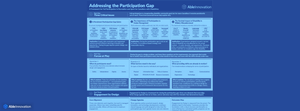
This is the Canada edition of Addressing the Participation Gap, one of four foundational publications from Able Innovation. Together they set out the case, the evidence, the vocabulary, and the international lessons for closing the participation gap in adaptive sport and recreation. The infographic provides an important visual narrative around the importance of adaptive sport and recreation, and the need for a structured approach to improve engagement. This edition states the case using Canadian data.
Five things to know
- The gap is real, and no one tracks it well enough to close it.
- Canadians with disabilities get a third fewer active minutes each week.
- 74% want to be active, but 1 in 3 say local options aren't accessible.
- Surveys capture snapshots and rarely link participation to what programs do.
- Increasing participation would have a positive impact.
- C$16.8B projected GDP gain from improved physical accessibility.
- C$6.8B a year in health care costs from physical inactivity.
- 21% lower economic cost for active people with disabilities (Korea).
- The community is bigger, older, and less visible than assumed.
- 1 in 4 Canadians has a disability, and 2 in 3 are affected by it.
- Nearly 9 in 10 use no visible aid.
- Fewer than 1 in 10 are children, yet much provision targets childhood.
- Closing the gap is a design problem.
- 4 needs: safety, independence, dignity, and access.
- 6 barriers that compound each other, so fixing one isn't enough.
- 5 shifts already under way that reward organizations who anticipate them.
- Engagement by Design is the framework to close it.
- 3 core elements: communications, experience, and technology.
- 3 change agendas: Discovery, Journey, and Scalability.
- Outcomes measured from day one.
Most figures come from published research. Three are Able Innovation estimates.
Able Innovation document #2026INFA02